Why A Stacked Setup Needs A Ceiling Check Most Single-Monitor Setups Never Do
Vertical stack ceiling clearance calculator: When purchasing desk hardware, most people simply don’t consider ceiling height because a single monitor on a desk rarely approaches a room’s ceiling. That is entirely altered by a vertical monitor stack. Two stacked panels, the arm’s base height, and the stack clearance gap can push the top of the setup three to four feet above the desk surface. In a basement, a converted attic room, or any other space with a lower-than-standard ceiling, that total height can actually become an issue rather than a theoretical one.
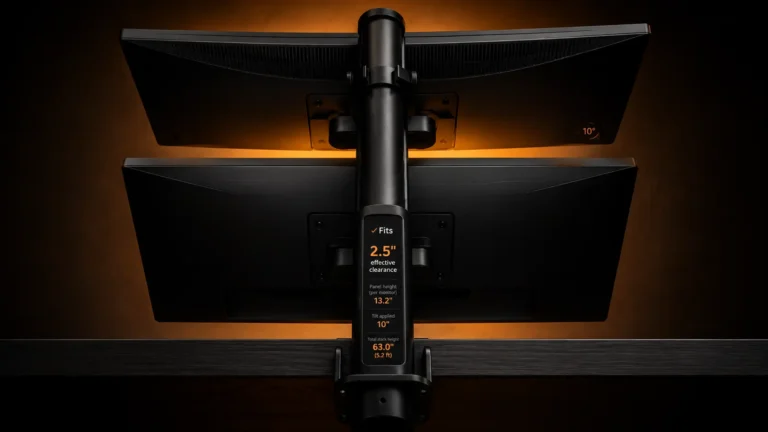
Vertical stack ceiling clearance calculator: This calculator calculates the height of a desk, the arm base and clearance, and the height of two stacked monitor panels. It then compares the result to the ceiling height of your actual room so you can determine, before purchasing, whether the stack will clear your particular space, rather than relying on the arm manufacturer’s generic assumptions.
Reading the results and what counts as enough clearance
Vertical stack ceiling clearance calculator: Arms seldom mount at the precise theoretical minimum height, leaving little margin for the tiny variations that come with actual installation, and the possibility of the top monitor sitting uncomfortably close to the ceiling even if it technically fits are both reasons to be concerned about remaining clearance under roughly 6 inches. Most rooms can accommodate 6 to 18 inches, but it’s important to check against anything else taking up that space, such as ceiling fixtures, sloped areas, or shelving above the desk. In most typical residential spaces, a clearance of more than eighteen inches is considered comfortable.
Vertical stack ceiling clearance calculator: Since even a fairly tall stack tends to land somewhere in the low five-foot range from the floor, most stacked setups are easily cleared by standard 8-foot ceilings, which are 96 inches. Particularly in basements, converted attic spaces, or older homes with lower ceiling heights, where the margin that a typical room takes for granted just isn’t there, this becomes a real planning concern. It is much less expensive to run the numbers here before ordering a stacking arm if your room fits that description than to find the issue after installation.
Frequently Asked Questions
How much ceiling height do I need for a monitor stack?
Vertical stack ceiling clearance calculator: When two 24- to 27-inch monitors are stacked on a typical desk, the top typically reaches a height of 5.5 to 6.5 feet. This is compatible with most 8-foot ceilings, but measure before purchasing a stacking arm if you have a basement or a room with a lower ceiling.
Does desk height affect how much ceiling clearance a monitor stack needs?
Indeed, directly. Because the stack rests on top of the desk surface, every inch added to the desk height results in an equal inch increase in the top-of-stack height. Compared to the same arrangement on a lower desk, a taller desk pushed toward the top of its adjustable range leaves less ceiling clearance.
Can a low ceiling basement room fit a vertical monitor stack?
When comparing converted spaces or basements to regular rooms, the precise ceiling height can vary significantly. Before making any purchases, measure the ceiling height in your room and compare it to the height of your desk, the size of your monitor, and the amount of room you require for your arms.
How is monitor stack height calculated?
Vertical stack ceiling clearance calculator: Add the desk height, the base and stack clearance measurements of the monitor arm, and the actual height of the two monitor panels stacked together. This sum must fit comfortably beneath the actual ceiling height of your room, measured from the floor.
Vertical Stack Ceiling Clearance Calculator | Monitor Stack Height Tool
Under-Desk Mount Torque Calculator | PC Mount Load Checker
Desk Boundary Bass Gain Estimator | Speaker Boominess Calculator




54 Comments