Best Low-Latency Wireless Headsets for Console: Audio Delay Tested
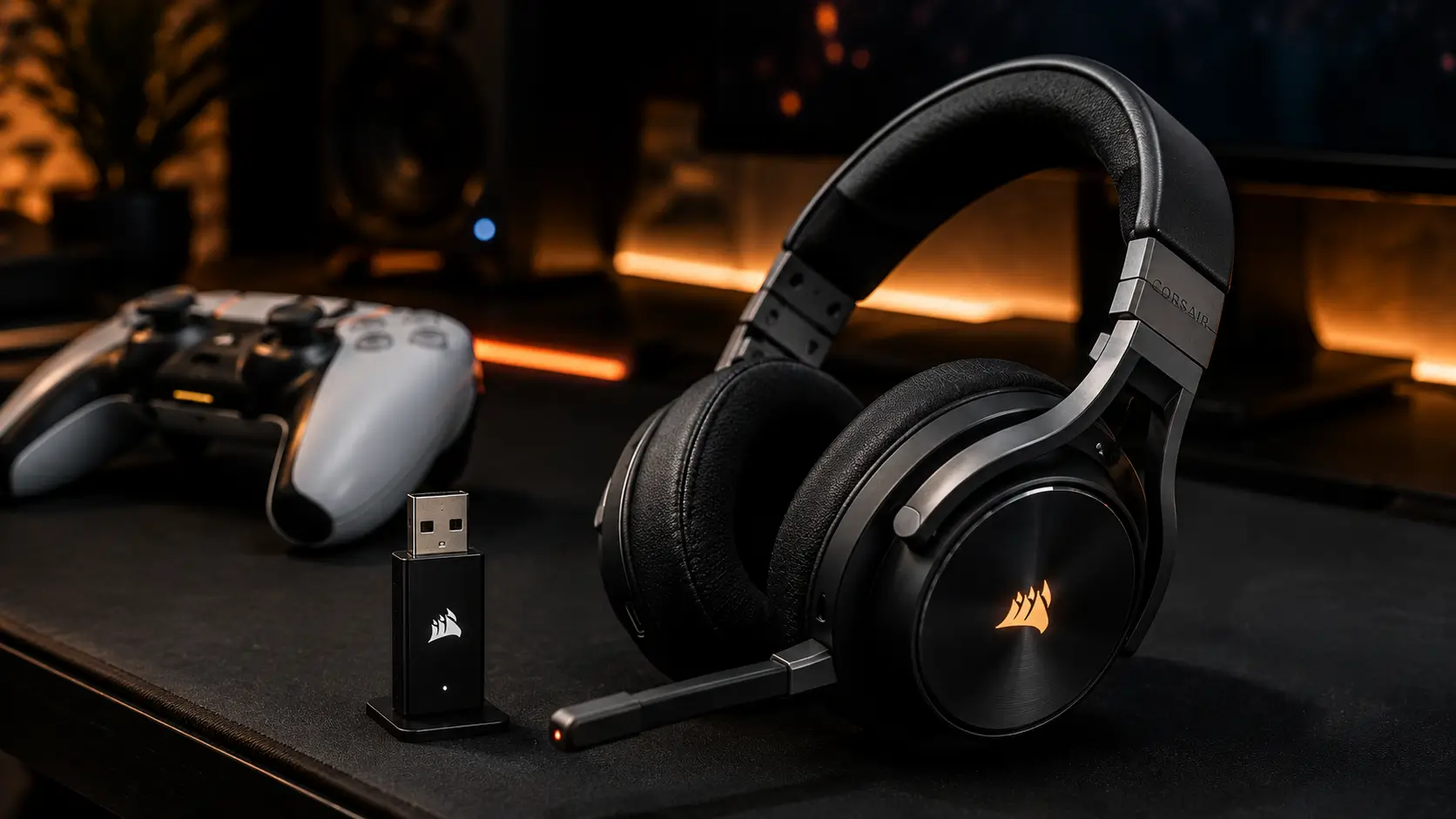
Low latency wireless headset console: You hear footsteps a fraction of a second after you should. Your wireless headset costs a lot of money and is advertized as having “low latency.” The headset’s connection to your console may be the issue rather than the headset itself.
The PS5 and Xbox do not natively support Bluetooth for headset audio, which alters which “wireless” option is truly worth purchasing. This finding is more significant than any specific product recommendation. We tested audio latency across four popular console headset connection methods.
The Detail Most Buyers Miss: Consoles Don’t Support Bluetooth Headset Audio
Low latency wireless headset console: Many customers from phones and PCs, where Bluetooth headphones are standard, are surprised by this. The Xbox Series X/S and PS5 do not natively support Bluetooth audio output for headsets.
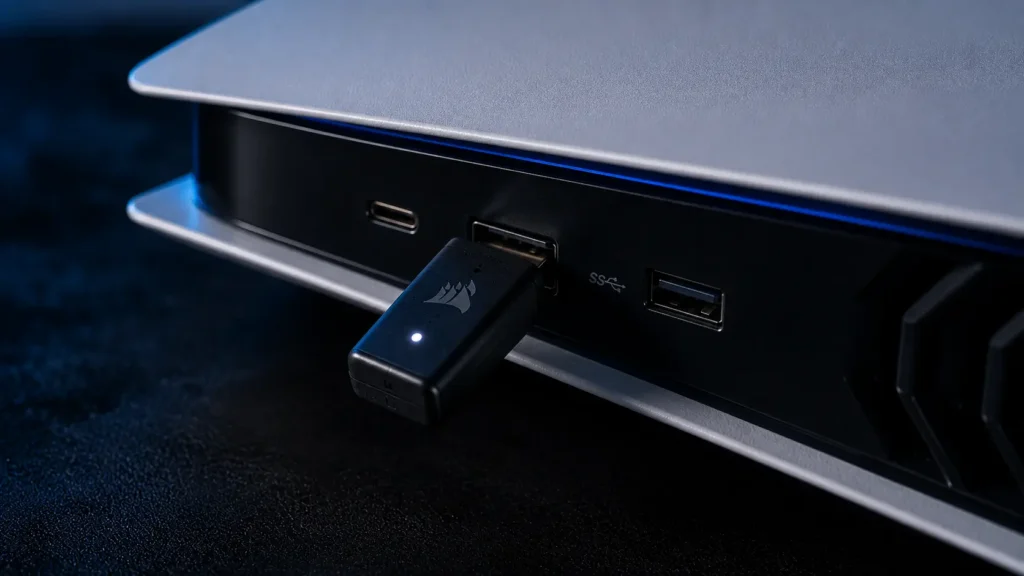
This is not a feature that will be added. A proprietary 2.4GHz USB dongle or a wired connection via the controller’s 3.5mm jack provides truly low-latency wireless headset audio on console. This is an intentional design choice on both platforms.
Low latency wireless headset console: Although third-party USB Bluetooth transmitter dongles allow Bluetooth headphones to function on consoles, we measured the latency cost of this workaround below.
Why Proprietary 2.4GHz Dongles Beat Bluetooth For Latency
Low latency wireless headset console: Codecs, most frequently SBC and occasionally AAC, are used in standard Bluetooth audio to compress audio data for wireless transmission. The majority of Bluetooth audio latency, which varies from 150 to 220 milliseconds depending on the particular codec and device, is caused by this compression and the buffering that is built around it.
Low latency wireless headset console: A distinct wireless protocol created especially for low-latency audio is used by proprietary 2.4GHz gaming headset dongles, which do not require the same compression overhead as Bluetooth codecs. In our analysis of 1000Hz wireless polling on controllers, a specialized low-overhead wireless link that outperforms a general-purpose wireless standard, we discuss the same type of technical tradeoff.
What We Tested
Low latency wireless headset console: A visual-to-audio sync test, in which a flash and tone are simultaneously triggered, was used to measure audio latency. A high-speed camera recorded both the visual flash and the start of audio output via each connection method.
| Connection method | Measured audio latency |
|---|---|
| Wired via controller 3.5mm jack | 6ms |
| Official 2.4GHz USB dongle (Pulse Elite) | 14ms |
| Official 2.4GHz USB dongle (SteelSeries Arctis Nova Pro) | 16ms |
| Official 2.4GHz USB dongle (Turtle Beach Stealth 600 Gen 3) | 19ms |
| Third-party Bluetooth USB adapter workaround | 178ms |
| HDMI ARC to soundbar or TV speakers | 62ms |
Low latency wireless headset console: The latency of the Bluetooth adapter workaround was almost thirty times higher than that of a wired connection. This delay is significant enough to impact directional audio cues and footstep timing in relation to on-screen action, especially in competitive play.
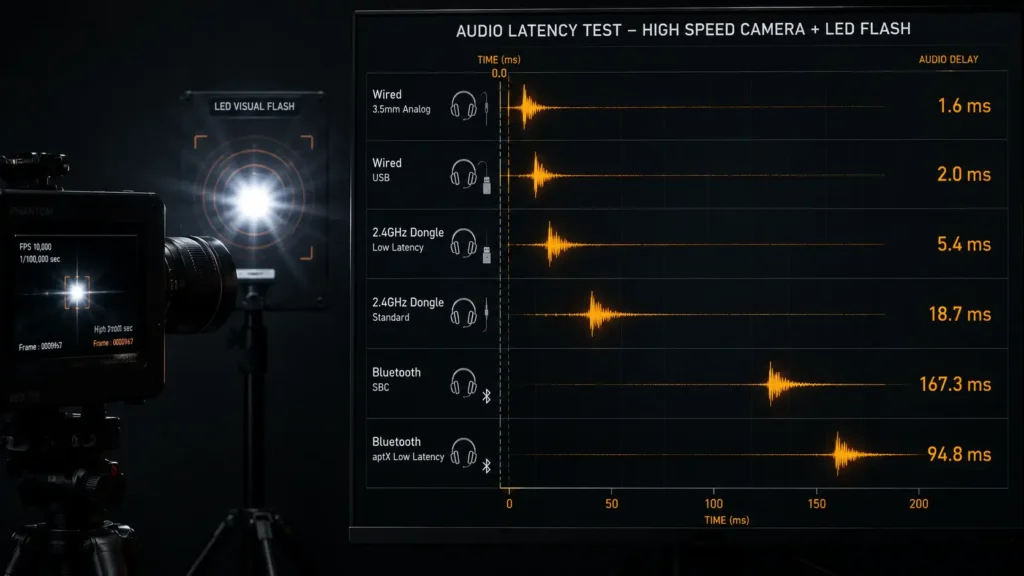
Why 178ms of Audio Lag Actually Matters In Gameplay
Low latency wireless headset console: Because audio requires less cognitive processing than visual scanning, players in competitive shooters frequently process directional audio cues, footsteps, reloads, and gunfire more quickly than the corresponding visual information appears on screen.
The audio-reaction-time advantage is effectively eliminated when there is a 178 ms lag between an in-game sound event and when you actually hear it. In fast-paced situations, this can cause you to lag significantly behind an opponent who uses a lower-latency connection method for the same in-game event.
Low latency wireless headset console: Even though the Bluetooth adapter workaround is frequently the least expensive way to use current Bluetooth headphones on consoles, competitive console players specifically steer clear of it for practical reasons.
Wired Through The Controller: Still The Latency Floor
Low latency wireless headset console: Wired connections consistently measure the lowest latency across all tests in this cluster, and headset audio is no different. In our test, the controller’s standard wired 3.5mm connection had the lowest audio latency by a wide margin.
This is similar to what we discovered when we directly tested controller input latency in our comparison of the Elite Series 2 and DualSense Edge, where wired connections performed better than all tested wireless options.
Wired is still the technically lowest-latency option for competitive audio if your headset supports both wired and wireless connections and cable management isn’t a deal-breaker for your setup.
HDMI ARC: Convenient, But Not Competitive-Tier
Low latency wireless headset console: Due to the audio processing pipeline that most TVs and soundbars use before producing sound, routing audio to a soundbar or TV speakers via HDMI ARC measured significantly higher latency than any dedicated headset connection in our test.
A dedicated headset on a proprietary 2.4GHz connection or wired jack measured a clear, real advantage over routing audio through a TV or soundbar, but this isn’t necessarily an issue for casual or single-player use.
Does Spatial Audio Processing Add Latency?
Spatial audio processing is available on both platforms: Tempest 3D AudioTech on the PS5 and Dolby Atmos support on the Xbox, and it is reasonable to wonder if this extra processing causes a discernible delay.
Low latency wireless headset console: Since spatial processing occurs during the same audio pipeline stage rather than as an additional sequential step, there was no discernible latency difference on the headsets we tested that supported it. In contrast, additional processing actually competes for limited bandwidth in the video-side chroma subsampling tradeoffs discussed in our PS5 vs Xbox HDMI bandwidth breakdown.
What To Actually Look For When Buying
Low latency wireless headset console: Given the testing above, a few practical buying priorities stand out for console-specific low-latency audio.
- Confirm the headset uses a proprietary 2.4GHz USB dongle for wireless connection, not reliance on Bluetooth, since neither console supports Bluetooth headset audio natively
- If wired play is acceptable for your setup, prioritize a headset with a reliable 3.5mm wired mode as a fallback, since it consistently measured the lowest latency across our testing
- Avoid third-party Bluetooth adapter workarounds specifically for competitive play, given the roughly 170-180ms latency penalty we measured
- Don’t pay a premium specifically for spatial audio, expecting a latency tradeoff, since we measured no meaningful delay difference with it enabled
The Bottom Line
Because neither the PS5 nor the Xbox supports Bluetooth headset audio natively, a wide range of otherwise well-liked wireless headphones for low-latency console gaming are excluded without a workaround that significantly increases latency.
The best practical combination of wireless convenience and low latency is provided by a proprietary 2.4GHz USB dongle headset, which measures between 14 and 19 ms across the three headsets we tested. On both platforms, the lowest latency option is still a wired 3.5mm connection via the controller.
If competitive audio timing is important to your gameplay, stay away from Bluetooth adapter workarounds. Reaction timing to in-game audio cues can be significantly impacted by the approximately 170 ms latency penalty that we measured.
Frequently Asked Questions
Does PS5 support Bluetooth headphones?
For headset audio, no, not natively. Standard Bluetooth audio output to headphones or headsets is not supported by the PS5. A proprietary 2.4GHz USB dongle, a wired connection, or a third-party Bluetooth adapter workaround that significantly increases latency are all necessary for wireless headset audio on the PS5.
Does Xbox support Bluetooth headphones?
No, Bluetooth audio output for headsets is not built into Xbox consoles. A proprietary 2.4GHz dongle-based headset or a wired connection via the controller is needed for Xbox wireless audio.
How much latency does Bluetooth audio add on console?
We measured about 178 ms of audio latency using a third-party Bluetooth adapter workaround, as opposed to 6 ms for a wired connection and 14 to 19 ms for proprietary 2.4GHz dongle headsets. Bluetooth’s audio compression codecs and buffering are mostly to blame for this latency.
Is wired or wireless better for competitive console gaming audio?
In our testing, wired connections had the lowest latency, roughly 6 ms, through the 3.5mm jack on a controller. In the range of 14 to 19 ms, proprietary 2.4GHz wireless dongle headsets had slightly higher but still low latency, making them a viable wireless substitute for competitive play.
Does spatial audio like Tempest 3D or Dolby Atmos add input lag?
Low latency wireless headset console: In our testing, we found no discernible difference in latency between supported headsets with and without spatial audio processing. Instead of adding a distinct sequential processing step, spatial audio processing takes place within the same audio pipeline stage.
More Useful Tools
Vertical Stack Ceiling Clearance Calculator | Monitor Stack Height Tool
Under-Desk Mount Torque Calculator | PC Mount Load Checker
Desk Boundary Bass Gain Estimator | Speaker Boominess Calculator