Onimusha: Way of the Sword CPU Benchmark: 31 CPUs Compared
Onimusha: Way of the Sword CPU Benchmark:
Tom’s Hardware used an RTX 5090 Founders Edition to run 31 CPUs through Capcom’s free Onimusha: Way of the Sword benchmark. Two outcomes stood out. The Core i9-14900K, Intel’s fastest chip in this game, is 11.3% behind the Ryzen 7 9800X3D. Additionally, Raptor Lake Refresh CPUs, which were introduced two generations earlier, outperform Intel’s newest component, the Core Ultra 7 270K Plus.
Onimusha: Way of the Sword CPU Benchmark:
The final discovery—that this game little cares about your CPU—is the one that truly modifies build recommendations. When combined with an RTX 5090, a 2018 Ryzen 7 2700X still achieved nearly 90 frames per second at 1080p Ultra without ray tracing. Because RE Engine is GPU-bound by design, the CPU scaling information provided here mostly indicates where your money is going.
Onimusha: Way of the Sword CPU Benchmark: If you’re planning a build around this title or the broader RE Engine catalog that now includes Resident Evil Requiem and Pragmata, the tier breakdown below is more useful than any single chart position. Here’s what the Onimusha CPU benchmark data actually means at each price point.
How Was the Onimusha CPU Benchmark Tested?
For the game, Capcom offers a free standalone benchmark on Steam and Epic. It is approximately five minutes long and consists of two real-time in-engine cutscenes followed by a gameplay portion. Instead than being a marketing demonstration, it is a repeatable CPU-scaling tool because it reports average FPS and 1% low FPS.
Onimusha: Way of the Sword CPU Benchmark: In order to eliminate the GPU as a bottleneck, testing paired each CPU with an RTX 5090 Founders Edition at 1080p Ultra with ray tracing off. The raw frame rates here will be significantly higher than what you’ll see on a true GPU at your actual resolution because that’s the proper way for separating CPU scaling.
One caveat worth carrying into the rest of this: the benchmark is a controlled sample of two scenes. Later chapters, effect-heavy boss fights, and post-launch patches can all shift performance, and the testing didn’t cover the game’s final areas.
Onimusha: Way of the Sword CPU Benchmark Results
Onimusha: Way of the Sword CPU Benchmark: X3D chips are ahead, but not by much. Compared to the Core i9-14900K, the Ryzen 7 7700X3D is 7.2% faster, and the 9800X3D is 11.3% faster. X3D margins are typically between 20 and 30 percent in CPU-intensive games. Here, they’re around half that, which indicates how much of the engine’s frame time is spent on the GPU.
There is hardly any separation between the X3D chips. It is difficult to defend the generational upgrade based just on this title because two generations of 3D V-Cache components land so close to one another. The Ryzen 7 5800X3D, which is four years old, can compete with much more recent flagship models.
Arrow Lake Refresh regressed. The Core Ultra 7 270K Plus, Intel’s newest chip in the test, finishes behind both the Core i7-14700K and Core i9-14900K. Part of that is Onimusha lacking support for Intel’s thread-scheduling optimization, which caps what the newer architecture can extract.
Onimusha: Way of the Sword CPU Benchmark: Ryzen 9 parts with twelve cores perform poorly. In this particular game, AMD’s more recent 12-core Ryzen 9 CPUs fall short of what their core count and pricing would indicate. The dual-CCD latency penalty for 12-core parts is the likely explanation, although testing revealed that RE Engine scales effectively up to 8 performance cores and 16 threads before stopping rewarding more.
Efficiency clearly favors AMD. The Ryzen 7 7700X3D achieved the highest test score of 3.5 fps per watt. If you’re sizing a PSU or cooler around a build, it matters that Intel’s Raptor Lake chips drew the highest power of anything evaluated.
Best CPUs for Onimusha: Way of the Sword by Budget
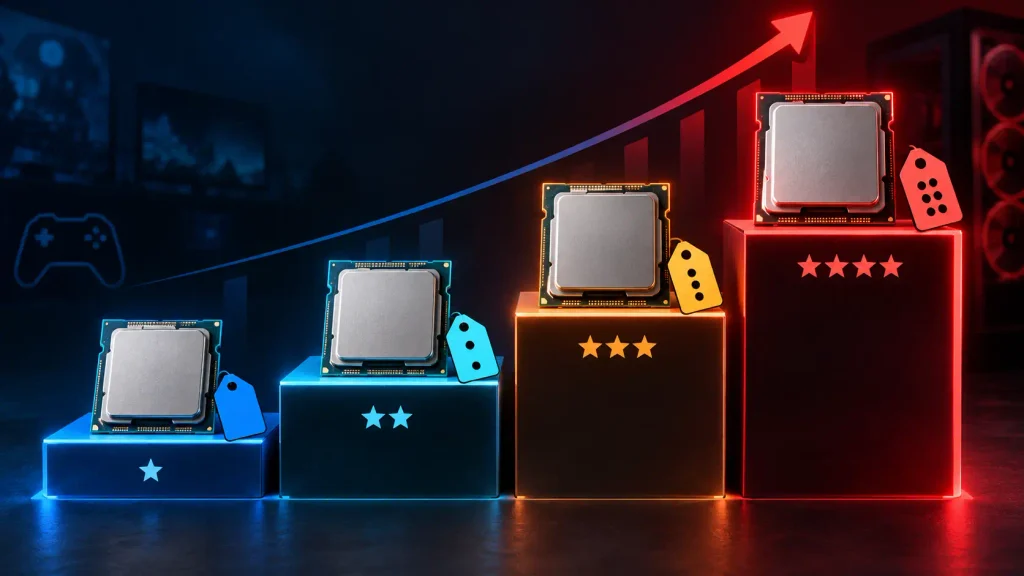
| Tier | Recommendation | What the data supports |
|---|---|---|
| Budget (under $150) | Ryzen 5 7500F, Core i5-14400F | Older 8-core parts like the 2700X still hit ~90 FPS at 1080p Ultra on an RTX 5090, so a current budget six-core is not the limiting factor |
| Mid-range ($150-$250) | Ryzen 7 5800X3D (existing AM4), Ryzen 5 7600 | 5800X3D keeps pace with modern flagships in this engine; no reason to replace one for this title |
| High-end ($300-$450) | Ryzen 7 7700X3D | 7.2% over the 14900K with the best efficiency in the test at 3.5+ FPS/watt |
| Enthusiast ($450+) | Ryzen 7 9800X3D | 11.3% over the 14900K, the fastest result in the 31-CPU run |
| Avoid for this title | Core Ultra 7 270K Plus, 12-core Ryzen 9 parts | 270K Plus loses to two-generation-old Intel chips; 12-core Ryzen 9 underperforms its price tier |
Onimusha: Way of the Sword CPU Benchmark: Note that the eight-core X3D parts beat the higher-core-count Ryzen 9 chips that cost more. That’s not a pricing quirk, it’s the engine’s scaling ceiling at 8 P-cores and 16 threads doing exactly what the testing found.
What CPU Do You Need for Onimusha: Way of the Sword?
Invest in the GPU if you are building exclusively for Onimusha. Despite the GPU-heavy nature of RE Engine, a flagship card and a 2018 CPU were still able to achieve 90 frames per second at 1080p Ultra. In the best scenario, switching from a mid-range CPU to an enthusiast one will save you about 11%. It costs a lot more to move up a GPU tier.
Onimusha: Way of the Sword CPU Benchmark: Don’t upgrade to this if you already have a 5800X3D. Here, it is comparable to more recent flagships. Instead, use that money for a display or graphics card.
The 7700X3D is the best option if you’re on AM5 and making a decision right now. It is the most power-efficient processor in the entire 31-CPU market and comes within 4% of the 9800X3D’s advantage over Intel at a significantly lower cost.
If you’re considering the Core Ultra 7 270K Plus, wait for broader benchmarks. Losing to the 14700K in a current AAA title is a real data point, but it’s one game with a known optimization gap. Don’t write off the architecture on a single result, and don’t pay a new-part premium for it based on this data either.
Onimusha: Way of the Sword CPU Benchmark: Don’t build around 12-core Ryzen 9 parts for RE Engine titles. With Resident Evil Requiem, Pragmata, and now Onimusha all on this engine, the scaling pattern is consistent enough to plan around. Eight strong cores with a large cache beats twelve cores split across two dies in this workload.
What Is the Best CPU for Onimusha: Way of the Sword?
The Ryzen 7 9800X3D is the fastest CPU for Onimusha: Way of the Sword, and the Ryzen 7 7700X3D is the one most people should actually buy. The gap between them is small enough that the price difference decides it, and the 7700X3D’s efficiency advantage is the tiebreaker if you’re building in a small case or on a modest PSU.
Onimusha: Way of the Sword CPU Benchmark: For everyone else, the more useful conclusion is that this game doesn’t justify a CPU upgrade. An 11.3% spread between the best chip in the test and a two-generation-old Intel flagship is not a build-defining gap, and the 2700X result proves the floor is far lower than the minimum spec suggests. Spend the money on your GPU.
Related CPU and Gaming PC Guides
- PC Builds & Benchmarks: link to tier-specific build guides for budget, mid-range, and enthusiast AM5 systems referenced in the table above.
- PC Components: link to a Ryzen 7 7700X3D versus 9800X3D head-to-head comparison for readers deciding between the two X3D tiers.
- Best Picks: link to a current “best CPU for gaming” roundup with street pricing rather than MSRP.
- News: link to coverage of Intel’s Arrow Lake Refresh and the Core Ultra 7 270K Plus launch for context on the regression finding.
- Tools: link to a CPU and GPU bottleneck calculator so readers can check whether their own pairing is CPU-limited at their resolution.
FAQs
1. Is Onimusha: Way of the Sword CPU intensive?
Onimusha: Way of the Sword performance depends on the CPU, GPU, resolution, graphics settings, and game scene. Some benchmark results show that GPU performance can also have a major impact on frame rates.
2. What is the best CPU for Onimusha: Way of the Sword?
The benchmark results show strong performance from Ryzen X3D processors, including the Ryzen 7 9800X3D and Ryzen 7 7700X3D. The best choice depends on your budget, graphics card, and existing platform.
3. Is the Ryzen 7 9800X3D good for Onimusha: Way of the Sword?
Onimusha: Way of the Sword CPU Benchmark: Yes. The Ryzen 7 9800X3D delivers strong gaming performance in the benchmark. However, users with an already powerful CPU should check their current CPU and GPU usage before upgrading.
4. Is the Ryzen 7 7700X3D worth buying for gaming?
The Ryzen 7 7700X3D can be a strong option for gaming, especially for users who want high performance and good power efficiency. Its value depends on its current price and motherboard compatibility.
5. Does Onimusha: Way of the Sword benefit from more than eight CPU cores?
Onimusha: Way of the Sword CPU Benchmark: The benchmark suggests that performance scaling may become limited beyond a certain core and thread count. However, results can vary depending on the game version, background tasks, and benchmark scene.
6. Is the Intel Core Ultra 7 270K Plus good for Onimusha?
In this particular benchmark, the Core Ultra 7 270K Plus performed behind some older Intel processors. This result should be viewed as one game-specific data point rather than a complete judgment of the entire CPU lineup.
7. Do I need a flagship CPU to play Onimusha: Way of the Sword?
No. You may not need a flagship CPU to play the game. Your target frame rate, graphics card, resolution, and graphics settings will determine the CPU performance you actually need.
8. Should I upgrade my CPU for Onimusha: Way of the Sword?
Onimusha: Way of the Sword CPU Benchmark: Before upgrading, check your CPU usage, GPU usage, average FPS, and 1% lows. If your GPU is already working at full capacity, a CPU upgrade may provide only a limited improvement.
9. Which CPU is best for high-FPS gaming in Onimusha?
Ryzen X3D processors are strong candidates for high-FPS gaming based on the benchmark results. The final choice should also consider the GPU, monitor refresh rate, game settings, and total system cost.
10. Are these benchmark results representative of every gaming scenario?
Onimusha: Way of the Sword CPU Benchmark: No. Benchmark results are affected by the test system, game version, graphics settings, resolution, and selected scenes. They are useful for comparison, but they should not be treated as a guarantee of performance in every situation.
Clilck below link for more guide
Laptop buying guide
Laptop processor comparison
Laptop repairability or teardown article
AI-Native vs Repairable Laptops: What Should You Buy in 2026?
More Useful Tools
Vertical Stack Ceiling Clearance Calculator | Monitor Stack Height Tool
Under-Desk Mount Torque Calculator | PC Mount Load Checker
Desk Boundary Bass Gain Estimator | Speaker Boominess Calculator